Access - Homepage and sign-out for MCP server portals
MCP server portals now display a homepage with organization branding, endpoint URL, and client-specific connection instructions. Authenticated users can sign out, which revokes OAuth grants and deletes upstream server states through Cloudflare Access logout with a confirmation summary.
MCP server portals display a homepage when users visit the portal domain in a browser.
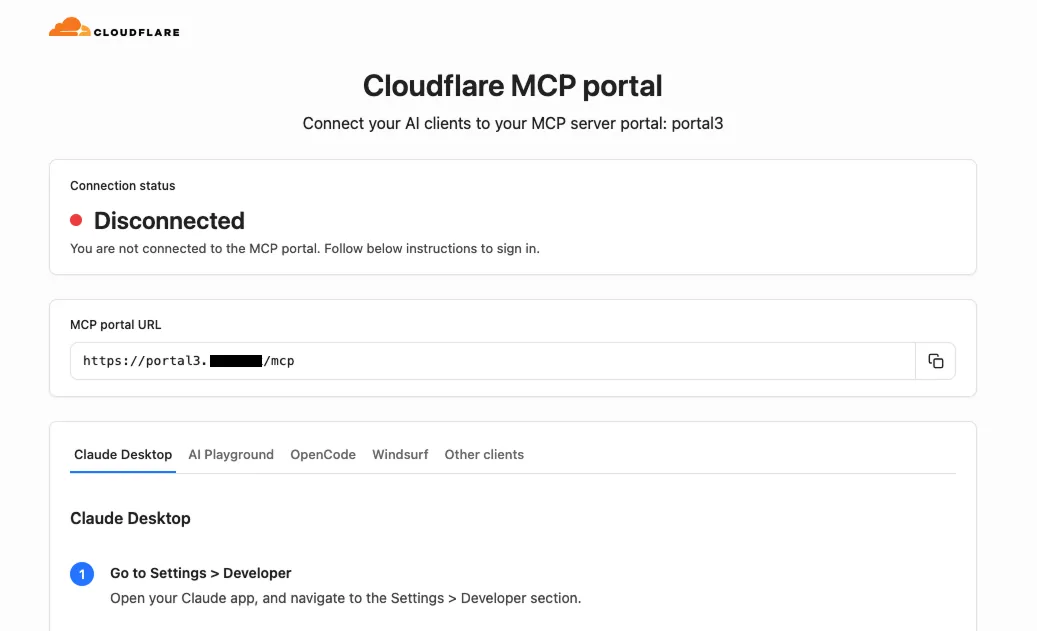
The homepage shows:
- The portal name and organization branding
- The MCP endpoint URL with a copy button
- Per-client connection instructions for Claude Desktop, Workers AI Playground, OpenCode, Windsurf, and other MCP clients
Authenticated users see their email address and a Sign out button. Selecting Sign out revokes all portal-level OAuth grants, deletes upstream server OAuth states, and redirects through Cloudflare Access logout. A confirmation page shows a summary of the revoked sessions.
For more information, refer to MCP server portals.
Source: original entry ↗
More from Cloudflare
Follow Cloudflare to get its new changes in your feed and email digest.
Cloudflare One Client for macOS 2026.8.2100.0
GA release for macOS Cloudflare One Client with improved split tunnel handling that no longer briefly blocks traffic during reconnects, support for non-RFC 1918 local IPv4 networks, faster connects with lower memory use, and numerous reliability fixes across DNS, reauthentication, and client stability.
Cloudflare One Client for Windows 2026.8.2100.0
This GA release improves split tunnel reliability, adds support for non-RFC 1918 local networks, optimizes connection performance with faster reconnections and lower memory usage, and includes numerous bug fixes for DNS, registration, and network handling. The client now features a service recovery mechanism that automatically restarts on system unlock and better handles large hosts files without blocking traffic.
Cloudflare One Client for Linux 2026.8.2100.0
New GA release for Linux with improved split tunnel handling that no longer briefly blocks traffic during reconnects, support for non-RFC 1918 local IPv4 networks, faster tunnel reconnections, and lower memory usage. Includes numerous stability and reliability fixes for DNS, reconnection behavior, and crash issues.