Workers - New resource-oriented REST API (Beta)
Cloudflare introduces a new REST API for Workers that separates concerns into three resources: Worker (parent resource), Version (immutable code snapshots), and Deployment (explicit traffic routing). The API supports creation of Workers before code upload, eliminates implicit deployments, and is designed for platform teams, development teams, and AI agents with support in Terraform and TypeScript/Go SDKs.
You can now manage Workers, Versions, and Deployments as separate resources with a new, resource-oriented API (Beta).
This new API is supported in the Cloudflare Terraform provider ↗ and the Cloudflare Typescript SDK ↗, allowing platform teams to manage a Worker's infrastructure in Terraform, while development teams handle code deployments from a separate repository or workflow. We also designed this API with AI agents in mind, as a clear, predictable structure is essential for them to reliably build, test, and deploy applications.
Try it out
- New beta API endpoints
- Cloudflare TypeScript SDK v5.0.0 ↗
- Cloudflare Go SDK v6.0.0 ↗
- Terraform provider v5.9.0 ↗:
cloudflare_worker↗ ,cloudflare_worker_version↗, andcloudflare_workers_deployments↗ resources. - See full examples in our Infrastructure as Code (IaC) guide
Before: Eight+ endpoints with mixed responsibilities
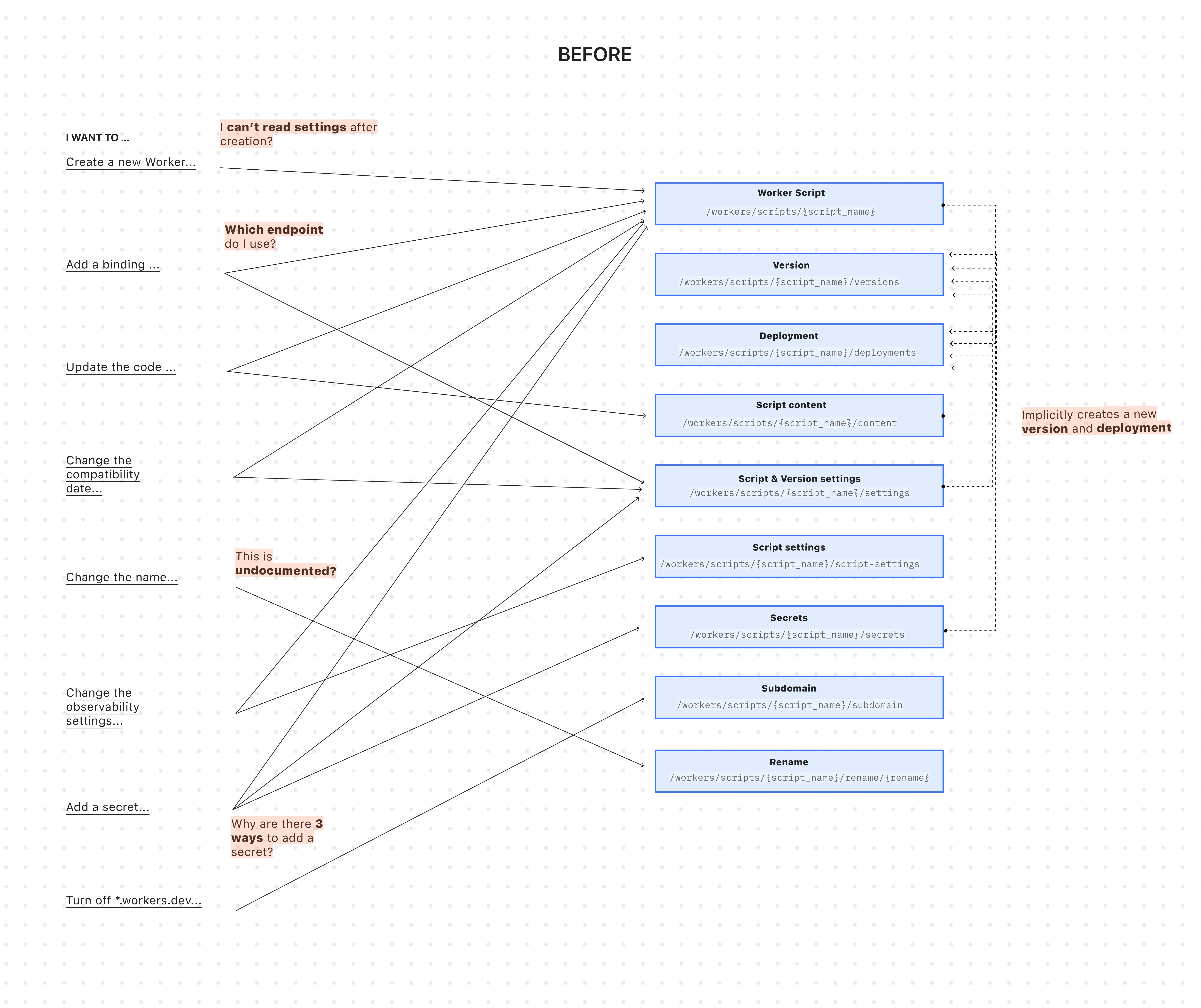
The existing API was originally designed for simple, one-shot script uploads:
curl -X PUT "https://api.cloudflare.com/client/v4/accounts/$ACCOUNT_ID/workers/scripts/$SCRIPT_NAME" \
    -H "X-Auth-Email: $CLOUDFLARE_EMAIL" \
    -H "X-Auth-Key: $CLOUDFLARE_API_KEY" \
    -H "Content-Type: multipart/form-data" \
    -F 'metadata={
      "main_module": "worker.js",
      "compatibility_date": "$today$"
    }' \
    -F "worker.js=@worker.js;type=application/javascript+module"
This API worked for creating a basic Worker, uploading all of its code, and deploying it immediately — but came with challenges:
-
A Worker couldn't exist without code: To create a Worker, you had to upload its code in the same API request. This meant platform teams couldn't provision Workers with the proper settings, and then hand them off to development teams to deploy the actual code.
-
Several endpoints implicitly created deployments: Simple updates like adding a secret or changing a script's content would implicitly create a new version and immediately deploy it.
-
Updating a setting was confusing: Configuration was scattered across eight endpoints with overlapping responsibilities. This ambiguity made it difficult for human developers (and even more so for AI agents) to reliably update a Worker via API.
-
Scripts used names as primary identifiers: This meant simple renames could turn into a risky migration, requiring you to create a brand new Worker and update every reference. If you were using Terraform, this could inadvertently destroy your Worker altogether.
After: Three resources with clear boundaries
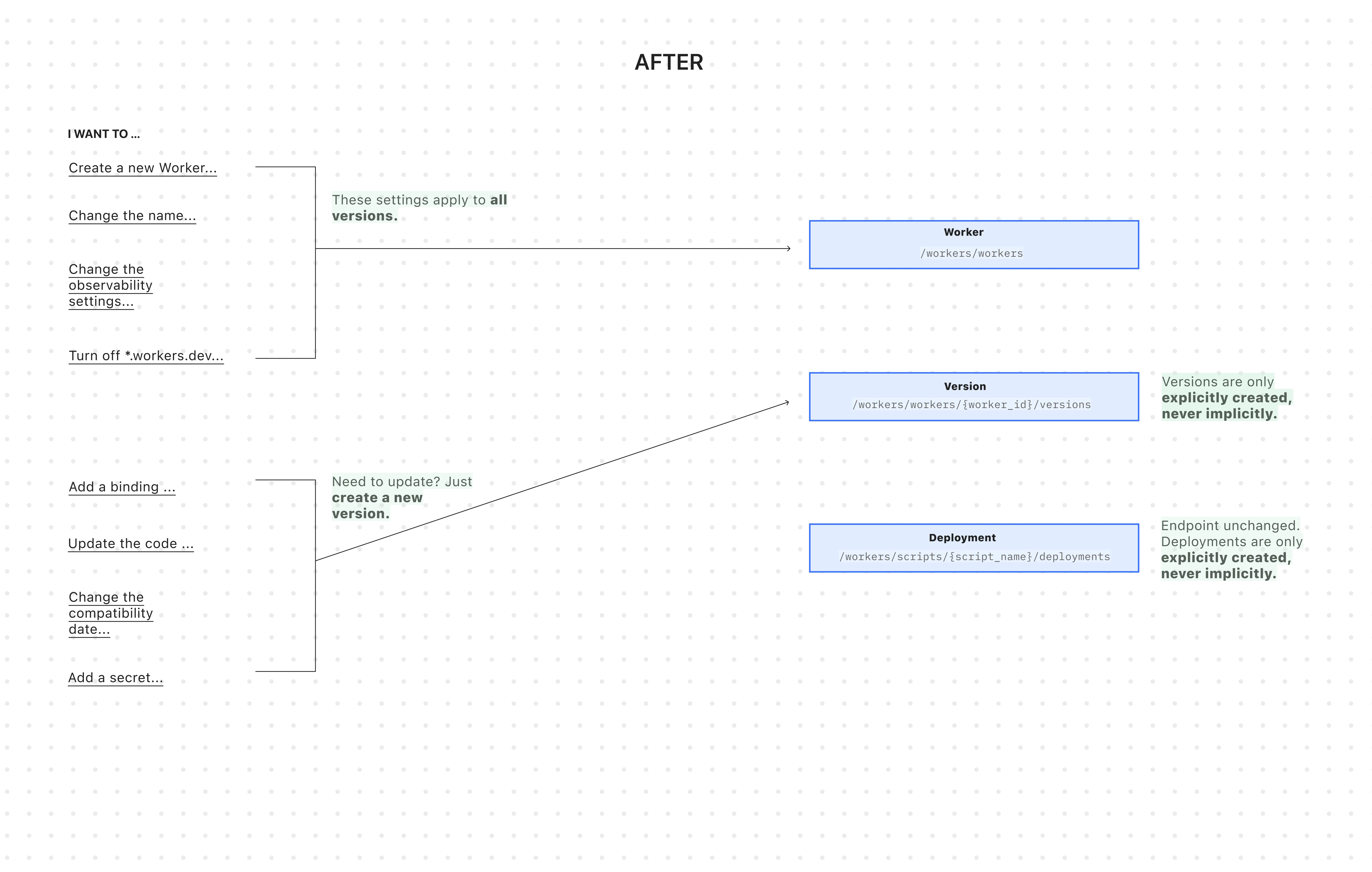 The new API introduces cleaner resource management with three core resources: Worker, Versions, and Deployment.
All endpoints now use simple JSON payloads, with script content embedded as base64-encoded strings -- a more consistent and reliable approach than the previous multipart/form-data format.
-
Worker: The parent resource representing your application. It has a stable UUID and holds persistent settings like
name,tags, andlogpush. You can now create a Worker to establish its identity and settings before any code is uploaded. -
Version: An immutable snapshot of your code and its specific configuration, like bindings and
compatibility_date. Creating a new version is a safe action that doesn't affect live traffic. -
Deployment: An explicit action that directs traffic to a specific version.
Note
Workers and Versions use the new /workers/ beta endpoints, while Deployments remain on the existing /scripts/ endpoint. Pair the new endpoints with the existing Deployment API for a complete workflow.
Why this matters
You can now create Workers before uploading code
Workers are now standalone resources that can be created and configured without any code. Platform teams can provision Workers with the right settings, then hand them off to development teams for implementation.
Example: Typescript SDK
// Step 1: Platform team creates the Worker resource (no code needed)
const worker = await client.workers.beta.workers.create({
  name: "payment-service",
  account_id: "...",
  observability: {
    enabled: true,
  },
});

// Step 2: Development team adds code and creates a version later
const version = await client.workers.beta.workers.versions.create(worker.id, {
  account_id: "...",
  main_module: "worker.js",
  compatibility_date: "$today",
  bindings: [ /*...*/ ],
  modules: [
    {
      name: "worker.js",
      content_type: "application/javascript+module",
      content_base64: Buffer.from(scriptContent).toString("base64"),
    },
  ],
});

// Step 3: Deploy explicitly when ready
const deployment = await client.workers.scripts.deployments.create(worker.name, {
  account_id: "...",
  strategy: "percentage",
  versions: [
    {
      percentage: 100,
      version_id: version.id,
    },
  ],
});
Example: Terraform
If you use Terraform, you can now declare the Worker in your Terraform configuration and manage configuration outside of Terraform in your Worker's wrangler.jsonc file and deploy code changes using Wrangler.
resource "cloudflare_worker" "my_worker" {
  account_id = "..."
  name = "my-important-service"
}
# Manage Versions and Deployments here or outside of Terraform
# resource "cloudflare_worker_version" "my_worker_version" {}
# resource "cloudflare_workers_deployment" "my_worker_deployment" {}
Deployments are always explicit, never implicit
Creating a version and deploying it are now always explicit, separate actions - never implicit side effects. To update version-specific settings (like bindings), you create a new version with those changes. The existing deployed version remains unchanged until you explicitly deploy the new one.
# Step 1: Create a new version with updated settings (doesn't affect live traffic)
POST /workers/workers/{id}/versions
{
  "compatibility_date": "$today",
  "bindings": [
    {
      "name": "MY_NEW_ENV_VAR",
      "text": "new_value",
      "type": "plain_text"
    }
  ],
  "modules": [...]
}

# Step 2: Explicitly deploy when ready (now affects live traffic)
POST /workers/scripts/{script_name}/deployments
{
  "strategy": "percentage",
  "versions": [
    {
      "percentage": 100,
      "version_id": "new_version_id"
    }
  ]
}
Settings are clearly organized by scope
Configuration is now logically divided: Worker settings (like name and tags) persist across all versions, while Version settings (like bindings and compatibility_date) are specific to each code snapshot.
# Worker settings (the parent resource)
PUT /workers/workers/{id}
{
  "name": "payment-service",
  "tags": ["production"],
  "logpush": true,
}
# Version settings (the "code")
POST /workers/workers/{id}/versions
{
"compatibility_date": "$today",
"bindings": [...],
"modules": [...]
}/workers API endpoints now support UUIDs (in addition to names)
The /workers/workers/ path now supports addressing a Worker by both its immutable UUID and its mutable name.
# Both work for the same Worker
GET /workers/workers/29494978e03748669e8effb243cf2515  # UUID (stable for automation)
GET /workers/workers/payment-service                  # Name (convenient for humans)
This dual approach means:
- Developers can use readable names for debugging.
- Automation can rely on stable UUIDs to prevent errors when Workers are renamed.
- Terraform can rename Workers without destroying and recreating them.
Learn more
Technical notes
- The pre-existing Workers REST API remains fully supported. Once the new API exits beta, we'll provide a migration timeline with ample notice and comprehensive migration guides.
- Existing Terraform resources and SDK methods will continue to be fully supported through the current major version.
- While the Deployments API currently remains on the
/scripts/endpoint, we plan to introduce a new Deployments endpoint under/workers/to match the new API structure.
Source: original entry ↗
More from Cloudflare
Follow Cloudflare to get its new changes in your feed and email digest.
Cloudflare One Client for macOS 2026.8.2100.0
GA release for macOS Cloudflare One Client with improved split tunnel handling that no longer briefly blocks traffic during reconnects, support for non-RFC 1918 local IPv4 networks, faster connects with lower memory use, and numerous reliability fixes across DNS, reauthentication, and client stability.
Cloudflare One Client for Windows 2026.8.2100.0
This GA release improves split tunnel reliability, adds support for non-RFC 1918 local networks, optimizes connection performance with faster reconnections and lower memory usage, and includes numerous bug fixes for DNS, registration, and network handling. The client now features a service recovery mechanism that automatically restarts on system unlock and better handles large hosts files without blocking traffic.
Cloudflare One Client for Linux 2026.8.2100.0
New GA release for Linux with improved split tunnel handling that no longer briefly blocks traffic during reconnects, support for non-RFC 1918 local IPv4 networks, faster tunnel reconnections, and lower memory usage. Includes numerous stability and reliability fixes for DNS, reconnection behavior, and crash issues.